The 30-second version
Contractor marketing in 2026 comes down to one question: when a homeowner in your service area searches for your trade, do they find you or your competitor? Everything below is about making the answer “you.” The short version: get your Google Business Profile into the map pack, run Local Services Ads if your trade qualifies, use Google Ads to buy the searches you can’t rank for yet, and build SEO underneath it all so your lead costs drop every year instead of rising. Skip the shared-lead platforms unless you enjoy bidding wars.
Where contractor leads actually come from
Ask ten contractors where their work comes from and nine will say referrals. They’re right, and nothing below replaces that. But referrals have a ceiling: they scale with your past customer count, not with your ambition. The contractors who grow past feast-or-famine add digital channels on top of word of mouth, in roughly this order of impact:
The Google map pack. When someone searches “roofer near me” or “electrician ross township pa,” Google shows three businesses on a map before anything else. Those three spots take roughly 40% of the clicks. Homeowners treat the map pack as a pre-screened shortlist, and if you’re not on it, you’re invisible to the people closest to hiring.
Local Services Ads. The “Google Guaranteed” listings above even the map pack. You pay per lead instead of per click, Google verifies your license and insurance, and the green checkmark does real work on trust. Most established trades qualify.
Google Ads. Paid search fills the gaps: searches where you don’t rank yet, neighborhoods where you want more work, and emergency terms where showing up first wins the job outright.
Your website. Not a lead source by itself, but the place every other channel sends people. A slow site with no click-to-call quietly kills leads that every other channel paid to generate.
Organic rankings. The long game. Service pages that rank for “[trade] + [town]” searches produce leads with no per-click cost, and they compound.
Social media sits deliberately last for most trades. Facebook can support awareness and retargeting, and project photos build trust, but almost no homeowner hires a plumber off Instagram. Prioritize the channels where people search with intent.
What contractor marketing actually costs
Industry benchmarks, not our prices, and every market differs. But going in blind is how contractors get burned, so here’s the honest landscape.
Marketing budget overall: most benchmarks put contractor marketing at 5-10% of gross revenue. Established companies with strong referral flow sit at the low end. Companies in growth mode or new markets sit higher.
Google Ads clicks for the trades run expensive. Nationally, contractor-related keywords typically cost anywhere from around $10 to $50+ per click, with emergency and restoration terms at the top of the range. This is exactly why unmanaged campaigns burn money: at those click prices, a loose keyword list wastes hundreds of dollars a week on searches that were never going to become jobs.
Local Services Ads charge per lead, not per click. Depending on trade and market, that’s typically somewhere between $25 and $350 per lead nationally. The good news: you can dispute junk leads, and you’re not paying for clicks that never call.
Shared-lead platforms (HomeAdvisor, Angi, Thumbtack) sell the same homeowner to three to five contractors at once. The per-lead price looks reasonable until you factor in the close rate against four competitors who got the same phone number. Most contractors we talk to have a horror story here. Exclusive leads from your own Google presence cost more effort up front and less money per closed job.
The pattern across all of it: channels you own get cheaper over time, channels you rent get more expensive. Budget accordingly.
Start with the foundation: website and Google Business Profile
Before spending a dollar on ads, two assets have to be right, because every channel funnels into them.
Your website needs to load fast on a phone, show your actual work, name the areas you serve, and make calling you a one-tap action. Homeowners search at 10 PM when the basement is flooding. If your site takes six seconds to load or hides the phone number, they hit back and call the next result. That’s the whole philosophy behind our contractor-focused web design: fewer bells, more phone calls.
Your Google Business Profile is arguably the single highest-leverage asset in contractor marketing, and it’s free. Categories, service areas, photos of real jobs, weekly activity, and a steady stream of reviews drive whether you crack the map pack. We wrote a full playbook for winning the map pack if you want the tactical detail, and our local SEO service runs that weekly routine for you if you’d rather be on a roof than posting to Google.
Local Services Ads: the pay-per-lead layer
If your trade qualifies for Local Services Ads, run them. Google verifies your license, insurance, and background checks, then badges you “Google Guaranteed” and places you above every other result type. You pay only when a homeowner actually contacts you through the ad.
Two things trip contractors up here. First, LSA rankings depend heavily on review count, response speed, and answer rate: a slow callback habit quietly buries your listing. Second, disputes matter. A portion of LSA leads are junk (wrong service, out of area, solicitors), and contractors who never dispute them overpay meaningfully. Managed well, LSAs are frequently the cheapest exclusive-lead channel a qualified trade has.
Google Ads: buying the top of the results
Paid search earns its keep for contractors in three places: emergency terms where first position wins the job (“burst pipe repair near me”), high-ticket services where one job pays for a month of clicks, and new service areas where you have no organic presence yet.
The difference between profitable and painful is management. Tight keyword match types, a negative list that grows every week, ads written around your trade instead of generic templates, and call tracking that ties every lead to the keyword that produced it. That last piece is non-negotiable: without call tracking you’re guessing, and at trade-level click prices, guessing is expensive. This is the core of our Google Ads management work, and if you’re weighing paid against organic, our breakdown of Google Ads vs SEO for small businesses gives the honest tradeoffs.
SEO: the compounding asset
Organic rankings take months to build, which is why impatient contractors skip them and stay stuck renting leads forever. The math favors patience: a service page that ranks for “deck builder south hills” produces leads every month with no incremental cost, and it keeps doing so while you sleep, while your ads run, and while your competitors keep paying per click for the same search.
Contractor SEO is mostly unglamorous work done consistently: service pages for each trade-plus-town combination that actually matter, project galleries with real photos, review velocity, citations that agree with each other, and a site Google can crawl without tripping. No secret sauce, just execution. Our SEO service covers the full stack.
A realistic timeline
Anyone promising floods of leads in week two is lying to you. Here’s what a realistic first year looks like when the work is done right:
Month 1: foundation. Website fixes or rebuild, Google Business Profile overhaul, call tracking installed, campaigns built. A few leads if ads launch early.
Months 2-3: Google Ads and LSAs producing steadily. The map pack starts moving in less competitive towns. You can see cost per lead by channel and it starts informing decisions.
Months 4-6: map pack positions firm up. Organic rankings appear for longer-tail searches. Blended cost per lead drops as free channels carry more weight.
Months 7-12: SEO compounds. The mix shifts from mostly-paid to increasingly-organic, which is the whole point: same lead volume, falling cost, and an asset you own instead of rent.
How to choose a contractor marketing agency
The contractor marketing space is crowded with national players selling templated sites and lock-in contracts. Whoever you hire, us or anyone else, run them through this filter:
Do you own everything? Website, domain, Google Business Profile, ad accounts, analytics. In your name, from day one. Agencies that keep your accounts are planning for how the relationship ends.
Is the reporting about calls and jobs, or clicks and impressions? You run a business, not a dashboard. Reports should answer one question: what did marketing cost and what work did it produce?
Do they know the trades? Ask what they’d do differently for an emergency plumber versus a custom deck builder. If the answer sounds the same, they have one playbook and you’re about to fund it.
Will they tell you no? A good agency will tell you when a channel isn’t worth your money or when your budget is better spent on reviews than on ads. Yes-to-everything is a sales strategy, not a marketing strategy.
The work behind this guide
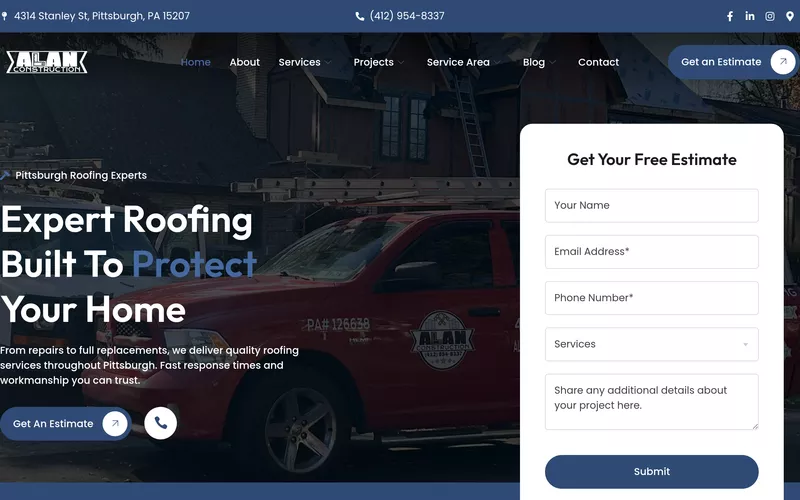
Everything above comes from doing it: websites, SEO, and ad campaigns for Pittsburgh-area contractors including Malick Brothers Exteriors, Alan Construction, and JL Home Builders, plus the movers, remodelers, and trades in between. Roofing companies have their own dedicated guide covering the specifics of that market in our roofing marketing breakdown, and if your trade is closer to landscaping or cleaning, the home services page covers that ground.
If you’d rather talk through your specific situation than read another word, the form above comes straight to the person who does the work. No sales team, no pressure, and if we’re not the right fit we’ll say so and point you somewhere better.